

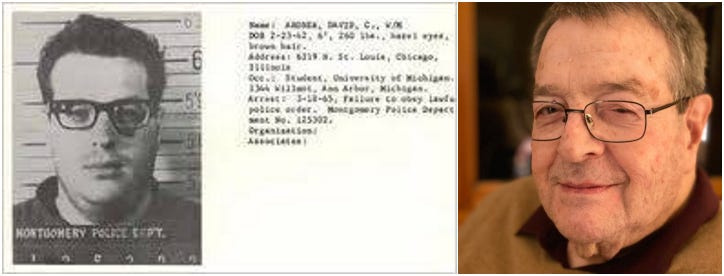
[This is a eulogy in honor of my friend, David Aroner. I hope that in our politically tribalized times, it might, for some readers, also serve as a portrait of the exemplary strength of character and openness of heart and mind —- of the indissoluble mutual respect for motives and life efforts, no matter how seemingly opposed —- that we so urgently need and have lost in the present moment and have so ruinously and suicidally abandoned over the last half-century.
David died in Berkeley on March 18. We had remained friends since our student days at the University of Michigan in Ann Arbor in the early 1960s. He had spent most of his working life as the strong and effective Director of SEIU Local 535 in the Bay Area and as a member of SEIU's International Executive Board, though he ultimately retired due to disagreements about the union’s direction during its Andy Stern era. Anyone who knows me knows my unfavorable opinion of much of SEIU’s political activities and initiatives over the years.
I sent the following eulogy to his widow, Dion. It was read at his recent October Memorial service in Berkeley by his grandson. This version contains some clarificatory expansions to better convey to unfamiliar readers the details and contexts as well as the mindsets of both the times and ourselves. I have also added two italicized paragraphs to flesh out the reasons and nature of my ‘divergence’.]
A Eulogy and an Appreciation of a Cherished Friend
I have lost the only remaining member of my small circle of friends from the early 1960s in Ann Arbor. David was the best and the most persistently communicative of that group, and I was by far the most withdrawn and reclusive. I am, by nature, neither withdrawn nor reclusive; indeed, in many contexts, I am quite the opposite. But I do not handle separation well at all, be it geographic or, as it is now, terminal and terrible. That is the only, woefully feeble reason I can adduce for taking so much time to send this statement to be read today.
David was a friend, a mentor, and in important ways, a kindred spirit. In our undergrad years, we shared similar political values. I was a New Deal Democrat, committed to the common man and reflecting my upbringing in a heavily ethnically enclaved small Pennsylvania working-class city. David was a more broadly aware and already strategically sophisticated progressive from Chicago. We shared, too, an appreciation and gratitude for the life enrichment provided by the fruits of America's cultural difference, as we then understood it.
An Accidentally Foretelling Analogy
I shall always remember a conversation, at what we then called an 'ethnic' restaurant, in Detroit, in which I made a crude analogy between how the food of other cultures opened our mental eyes to the brilliance of simple foods from simple ingredients achieved by common people working within different traditions and constraints and struggles for sustenance; and how, in much the same way, the very politically engaged ‘Weavers' [whom we both venerated] frequent use of simple, traditional folk melodies opened our hearts to the often unforgettable expressions of common people of their hopes, fears, joys, amid their broader struggles.
We both played around with that analogy and David returned to it frequently thereafter. Unbeknownst to us at the time, it both described the core of our shared commitments and foretold the basis, nature, and direction of the eventual diverging paths which we chose to pursue them. Those commitments —- and our even stronger commitment to each other’s integrity and sincerity —- held us together, despite diverging political visions, for more than six decades.
David was a kindred spirit, too, in a big, important way. We both held a deep sense, even then, that we should live our lives in deep dedication, as callings or vocations. He already knew the specific occupational role through which he would express his dedication. I had no idea of how I would go about mine. To this day I have no definitive answer. After leaving academia, I just imposed it, as best I could, into whatever role life thrust me into.
But the targets of our dedication remained similar. David's were the unfairly and unjustly treated working people, life’s victims [though the term is now profoundly fraught] and those who deserved better from it. Mine were the 'little and ordinary people', overlooked, discounted, and taken for granted in life today and forgotten by traditional history. Those who, over millennia --- most of them working in unimaginably laborious conditions --- had nonetheless created, small idea by small idea, the world of luxury we were born into.
Civil Rights, SDS, and Viet Nam
I first met David as a mentor when, in my junior year at Michigan, he would spend hours in the Michigan Daily building, where I was at first a staff writer and later a tangential member of a group of SDS and like-minded friends who discussed and argued about how best to address the main issues of the day: Civil Rights, the 'multiversity', the growing Viet Nam involvement, and the like.
David --- always calm, patient, contextualizing, avoiding the spotlight, and focused on the importance of coalition building --- took the time to localize for me the more abstract and campus/class-based discourses of the SDS group, particularly with references to his work with Ann Arbor CORE.
Gradually, he convinced me to attend CORE meetings, where I met a group of good, racially and economically diverse people dedicated to the (now quaint --- if not actionable) goals of racial integration and equality. CORE also gave me my first opportunity to contribute whatever knowledge of media and messaging I had acquired at the Daily.
Shifting Foci, Locations, and Commitments
In time, David began working in Detroit', and I remained in Ann Arbor. With the passage of the Civil Rights and Voting Rights Acts, I shifted focus to the early stages of opposition to the Vietnam War escalation and the early faculty-student meetings that conceived and planned the first Vietnam Teach-In. From there, I became active in UM/Ann Arbor SDS and eventually its chairman during the tides of opposition that dominated 1965 and early 1966.
I believe David moved to Berkeley in 1966 where, Alinsky-trained, he began his rise to prominence in SEIU, becoming the Executive Director of its Bay Area Local and then a member of its International Executive Board. We remained in contact throughout as co-activists on what we continued to understand broadly as the same side.
Within a year, however, I began to withdraw from SDS and slowly from the Ann Arbor left and its factional conflicts and began questioning what my deepest commitments were and where they should lead me.
Ultimately, they led me to grad school in social history (of the ignored common people who held no offices and left any written memoirs, letters, official papers, etc.) and then out of academia, out of the battles within leftist politics, and out of the nascent outbreak of the multiplicity of now dominant, but even then insupportable identitarian, grievance, and ‘critical’ ‘studies’ ‘disciplines’ --- that I had foreseen and tried to oppose --- that the campus left was splitting and lurching towards at the time. I continued my involvement, but more now as a kind of picky, free-lance mobilization and educational event consultant.
[A Clarificatory Summary of My Political Evolution]
[Over time, I accepted with more clarity that I had been moving steadily to the adoption of what had become a foundational, defining wariness and critical assessment of the class implications revolutionary intellectuals; and of the unhappy realities involved in efforts to impose their abstractions on real individuals and social systems.
I have reached and sustained this adversarial mindset by lifelong reading of the works of Fyodor Dostoyevsky and scholarship about him and about the ideas, questions, and prescient fears that obsessed him. In a similar but less thorough manner I had moved to a Burkean-Tocquevillian [and many others] gradualist reformism and an attendant respectful embrace of civil society, custom, and tradition.
Thus, I came to recognize the need for change —- but change undertaken within a rigorous consideration of all its likely consequences —- conducted with profound gratitude and appreciation for the innumerable gifts and achievements bequeathed to us, unearned, by the innumerable great and small efforts of our antecedents: most of them insignificant and un-noted 'common people'. At the national political level, I developed a deepened gratitude for the wisely configured edifice of balanced powers in our Constitutional Republic.]
Divergence and a Quest for Understanding
This kind of thinking led far from the comfort of the then-termed, ‘liberal’, sanctuary we had shared since we met. It began the process by which our broadly unified beliefs at the political —- though not then or ever at deeper —- levels began clearly to diverge. For me, SEIU, in its political activities, had become an enemy.
Throughout that period, David was the one who persistently made unceasing, if frequently mystified, efforts —- across the widening political gap that has rent our society but did not rend us —- to call; to inquire; to probe; all to understand better why and how I had arrived at what my other former Ann Arbor leftist friends understood as outright and intolerable apostasy.
I doubt that for most of those years, I explained or fully understood the process myself well enough to make him understand it all clearly. We would discuss a few timely issues; he would probe; I would explain my thoughts and positions; and then we would both affirm that commitment to each other and to history’s 'little people'. That never wavered.
Real Changes Collide
For me, what had greatly, truly, and irreparably wavered was my old, New Deal faith in the beneficial impact of the now massively expanded state. Indeed, that state had grown beyond New Dal imaginations. It now funded, controlled, and sought to replace ever-greater segments of public and private life and eradicated all but harassed pockets of what was once a defining, vibrant, and diverse civil society. It had shifted to policies and goals directly opposite those I had been born into and supported.
Living through this expansion only strengthened my corollary, working-class-based fear of the inevitability of a society divided between a modern Hegelian one-party ‘universal class’ of those conformed enough to be allowed within the affluent ranks of formal controllers and those with connections to them; and the mass of those whom they would, probably inevitably and destructively, control.
All of this collided with David's consistent lifelong faith that the wisely conducted and untiring pragmatic hard work of organizing society's underdogs --- and strongly supporting throughout his life those whom he was not in a position to organize --- would result in progress and a better nation and world. I believe he held that vision strongly to the end, though he had expressed to me at least a degree of perplexity at some of the directions taken in recent years.
Communication and the Effort to Understand
In our phone conversations of the last decade or so, though, David remained my loyal friend, who placed and kept loyalty above political difference, as I hope I succeeded in doing with him. He always made efforts to communicate while I was frequently too wrapped up in my head to do so. He tried his best to understand --- in his elegant, vanishing, pre-cancel-culture sense of friendship -- through the decades when I was not yet able to explain it all with the clarity worthy of his interest and concern.
At many times, one of us felt the other’s ways of understanding and promoting our beliefs to be misguided; he likely more frequently than I. It is a tribute, due more to the depth and open-mindedness of his commitment than it is to mine, that an old understanding from our youth that we had developed in a different world was able to survive, thrive, expand, and uplift our minds, hearts, and souls through a half-century of societal fragmentation and turmoil, until my final call to him on his last birthday in March.
He was, for me, a solid, unwavering rock --- as I'm sure he was to Dion, his family, and his many, many friends --- standing tall and broad in a landscape of relative pumice pebbles blown about by shifting winds. I often had a strong premonitory sense of when he might be likely to call. I counted on hearing him, sharing updates on our various ailments [his far more trying than mine], discussing politics with no intent to change each other’s minds, and reasserting the friendship that endured through our dissimilar life journeys.
I shall miss those calls; I shall miss even more the ability to be secure in his loyalty, even when being open and honest; and above all, I shall miss the opportunity to convey to him --- this time, for eternity --- better and more directly than ever before, the depth of my gratitude for his lifelong friendship and loyalty. R.I.P., my friend.
Peter di Lorenzi